Two hunters have until dawn to steal the book that holds the debts of an entire community — and decide who, if anyone, should own it.
Case file
- The pitch
- St. Francisville: the real history
- Keeper’s truth
- Rules on one page
- The hunters
- Scene 1: Voss Rare Books
- Scene 2: St. Francisville by day [Adaptation]
- Scene 3: The house
- Scene 4: The study
- Scene 5: The grab
- Scene 6: The river road
- Scene 7: The handoff
- Endings
- Keeper cheat sheet
The pitch
October 1986. The oil money is gone and the for-lease signs are up from Baton Rouge to Natchez. A rare-book dealer is paying $20,000 cash for one book. It belongs to an old man in St. Francisville, La. Everybody in the parish owes Elias Crane something. Nobody remembers what.
Two hunters have until dawn to steal the book that holds the debts, and to decide who, if anyone, should own it next.
This is The Ledger, run on Hunters, Inc. rules (SHADIS #32), for two hunters and a Keeper. Plan on four to six hours: four is possible for a direct group, while investigation-heavy players will often run five or six. Anything new is marked [Adaptation].
How the day and night unfold
Voss hires them on the morning of Friday, October 10, 1986, and wants the book on her counter before dawn Saturday. That gives them one day of legwork and one night of work.
| # | Scene | Time | Tension beat | What the players walk away with | Length |
|---|---|---|---|---|---|
| 1 | Voss Rare Books | Fri 9 a.m. | Normal world → hook | A job, cash up front, a client hiding something | 20 min |
| 2 | St. Francisville by day | Fri afternoon | Small answer | Land and home deeds that don’t add up, and a gas station clerk who’s too helpful | 40 min |
| 3 | The house | After dark (~11 p.m.) | Escalation | Armed guards, timed response, a way in | 45 min |
| 4 | The study | When they reach it | Surprise | The book binds people and feeds Crane. He makes a counteroffer. | 30 min |
| 5 | The grab | Immediately after | False resolution | They have the book. Crane is aging. It worked. | 20 min |
| 6 | The river road / Cal branch | After the escape or earlier | Bigger twist | The last two hunters are in the book, and Voss sent them; Cal may be obstacle or ally | 30 min |
| 7 | The handoff | Before dawn | Maximum tension → climax | Voss’s real aim, and the choice | 20 min |
| — | Endings | Dawn | Aftermath | What follows them home | 15 min |
Pacing note: these lengths are targets, not guarantees. If the players question Nita, work the courthouse deeply, surveil Cal, or build a careful infiltration plan, the daytime legwork can easily consume two hours of table time. Do not rush good investigation merely to preserve a four-hour estimate.
St. Francisville: the real history
These are verified events in and around St. Francisville, in order. Use them as texture, clues, or NPC small talk.
| When | What happened |
|---|---|
| 1790 | John Mills and Christopher Stewart open a trading post at Bayou Sara, on the river below St. Francisville. It becomes the most important landing between New Orleans and Natchez. [1] |
| Sept. 26, 1810 | Rebels declare the Republic of West Florida independent from Spain, with St. Francisville as its capital. Its flag is a single white star on a blue field. It lasts about two and a half months; St. Francisville accepts U.S. control on Dec. 6, 1810. [2] |
| 1821 | John James Audubon arrives at Bayou Sara. He spends four months as a tutor at Oakley Plantation and paints 32 birds there. [1][3] |
| May 22 – July 9, 1863 | The Siege of Port Hudson, about 25 miles upriver from Baton Rouge: 48 days, the longest siege in U.S. military history to that point. On May 27, the Louisiana Native Guard, Black Union regiments, charge the Confederate works. [4] |
| June 12, 1863 | The USS Albatross shells St. Francisville, including Grace Episcopal Church. Its commander, Lt. Cmdr. John E. Hart, a Mason, takes his own life aboard. Union sailors carry his coffin up the bluff under a white flag. Confederate Mason W.W. Leake arranges his burial at Grace Church with full Masonic honors, and the fighting stops for the funeral. The town still reenacts it every June. [5] |
| After the war | William Drew Winter is murdered at the Myrtles, the only verified killing in the house. The famous ghost legends (Chloe, the poisonings) aren’t supported by the records; the Woodruff children died of yellow fever. The year of Winter’s murder is unconfirmed. [6] |
| 1880 | Samuel James buys the Angola plantations and works them with leased convicts, many of whom die. Angola becomes the state prison in 1901. It’s about 22 miles northwest of town and covers 18,000 acres. [7] |
| 1927 | The Mississippi flood washes Bayou Sara away. The same flood destroys Angola’s prison cemetery. [1][7] |
| 1947 | Oakley becomes Louisiana’s ninth state park. [3] |
| Feb. 1951 | 31 Angola inmates cut their own Achilles tendons in protest; by May the number is 55. In 1952, Collier’s calls Angola the worst prison in America. [7] |
| 1960, 1963 | Greenwood Plantation’s house burns to the ground (1960). Fire destroys Afton Villa (1963). [8] |
| 1960s | Leonard Charrier, a guard at Angola, spends three years digging up Tunica graves at Trudeau Landing and tries to sell the artifacts to Harvard’s Peabody Museum. [9] |
| 1965 | The first Angola Prison Rodeo. [7] |
| 1983 | A local paper covers the St. Francisville ferry, still how people cross the river there. [3] |
| 1986 | A Louisiana appeals court rules against Charrier in Charrier v. Bell. The Tunica-Biloxi tribe keeps title to its ancestors’ grave goods. [10] |
| June 16, 1986 | River Bend begins commercial operation. [11] |
My best fits for The Ledger
- Charrier v. Bell is the strongest. An Angola guard who robbed graves, a rare-artifacts deal through Harvard, and a ruling the same year the adventure is set. Voss, a rare books dealer, would know the case.
- The 1963 Afton Villa fire fits Crane, who won’t allow a fire in his house. A great house burning the year after “Elias Crane III” inherited is a fact he has reason to fear.
- Bayou Sara’s washout in 1927 covers the “sons.” Records kept down at the Bayou Sara landing and lost in the flood are a believable gap in Crane’s paper trail, four years before “Jr.” inherits.
- The Hart burial is a ready-made scene. Grace Church cemetery, where enemies once called a truce, is a good place for the handoff or a parley. It also hints that the town has had these kinds of deals that are older than Crane’s.
- The ferry can replace the road chase. With no bridge, a hunter running with the book across the river has to wait for the ferry, and Cal knows it.
Why 1986
The town is broke. Oil crashed that spring, and Louisiana had the highest unemployment rate in the nation. Up the road, the River Bend nuclear plant started commercial operation in June, and its construction jobs are drying up. Desperate people sign things. Crane has been buying debts for ninety years, and this is a good year for it.
Sources
- Bayou Sara, Louisiana (Wikipedia)
- Republic of West Florida (Wikipedia)
- Regional History: West Feliciana Parish (Southeastern Louisiana University archives)
- Siege of Port Hudson (Wikipedia)
- The Day the Civil War Stopped (Atlas Obscura)
- Legends of Myrtles Plantation (Wikipedia)
- Louisiana State Penitentiary (Wikipedia)
- West Feliciana (64 Parishes)
- Tunica treasure (Wikipedia)
- Charrier v. Bell case brief
- River Bend Nuclear Generating Station (Wikipedia)
Keeper’s truth
The horror is leverage: the book turns other people’s lives into more life for whoever owns it and physically possesses it. Elias Crane has owned it since 1894.
How a name goes in. The owner cuts the debtor’s palm, then their own, and writes the name in the mixed blood. The debtor doesn’t have to agree; a bargain just makes the idea go easier. Most of the parish signed for something: a loan, a light bill, a truck note in a bad year. Nita and Cal were forced.
What the book takes. Every name feeds the owner of the book a little of the debtor’s life. The owner stops aging. The debtor ages a little faster, sleeps a little worse, and feels pressure to fulfill the obligation established when the debt was created. The Ledger is not open-ended mind control. The Named can refuse; refusing causes pain and psychological strain.
What happens over time. The book degrades over time as the people in it eventually die… sooner than is natural in most cases, not counting unnatural deaths. The ink flakes off of the page. So the owner has to keep adding names. A full book of names keeps its owner young and strong while the Ledger is physically in that owner’s possession. A book low on names begins to degrade along with Crane.
Why now. Crane has been losing ground for twenty years. The families who signed in the 1920s and ’40s are dying off. Then the oil bust delivered a parish full of desperate people. That’s why he kept Nita and Cal instead of killing them: two healthy adults. Decades of life.
What Voss wants. Maren Voss has studied the book for twenty years. Her stolen-heirloom story is a lie. She wants Crane’s book and the life it feeds, and she knows the book has more names in it now than it has in a generation.
Crane’s sons [Adaptation]
A guy who never ages needs a new name every generation, Highlander-Style. Crane has “died” twice. In 1931, Elias Crane Sr. was buried in a closed casket and the house passed to Elias Crane Jr. In 1962, Jr. died the same way and left everything to Elias Crane III. A Baton Rouge law firm handled both estates… a law firm with a lot of family names in the book.
The locals have noticed: “the Crane men always did favor each other.”
The last pair [Adaptation]
In the spring of 1984, Voss hired two hunters, Nita Ames and Cal Rousseau, to go after the same book. Crane’s men took them alive, and Crane wrote their names in the ledger. Two years later they still live in St. Francisville. Nita works the register at the Fina station on US 61. Cal drives for Crane. Neither remember when they decided to stay.
Hard limits
- Crane is a man sustained by the book; nothing supernatural beyond that. (Of course Keepers can make an executive decision about that as needed.)
- The four guards are well-paid criminals, not tied to the book.
- Possession and ownership are different. Physical possession cuts the current owner off from the life the Ledger feeds them, but it does not transfer control of the Named. Crane can still command Nita and Cal while the hunters are carrying the book.
- Claiming the Ledger [Adaptation]: a new owner must deliberately claim it by putting a drop of their own blood on the inside cover while physically holding it. Existing debts then transfer immediately. Killing the current owner does not by itself transfer ownership; the killer still has to claim the Ledger.
- Binding a new debtor takes the debtor’s blood, the owner’s blood, and the debtor’s name written in the Ledger. The debtor does not have to consent.
- The obligation is fixed at binding. The owner establishes what the debt requires when the name is entered. The Named can be pressured to fulfill that obligation and to rationalize behavior that serves it, but the owner cannot invent unrelated commands later. Nita and Cal’s terms include remaining available to Crane, protecting him and the Ledger, not exposing what happened, and returning when they try to leave.
- Distance does not break the debt. The obligation travels with the Named, but its scope never expands beyond what was established at binding.
- An unclaimed Ledger keeps its existing names bound but gives no one active control or life from them until somebody claims it. If the current owner dies before anyone else claims the Ledger, it becomes unclaimed.
- Removing a page does not sever a debt. An inscribed page remains supernaturally part of the Ledger. If it is put back into the book, the torn fibers knit together and the page reattaches seamlessly.
- Selective fire [Adaptation]: burning a removed inscribed page completely ends only the bindings written on that page. The rest of the Ledger survives. Returning the page before it is destroyed restores it to the binding.
- Burning the whole Ledger ends every binding and destroys the book utterly. Crane dies because the years the Ledger has held back catch up with him at once. A newer owner does not automatically die from its destruction. (Crafty Keepers might say that the ashes can be used in some way to make a similar relic, muwahaha.)
- Once the Ledger leaves Crane’s physical possession, he starts aging fast even though he remains its owner until someone else claims it.
Rules on one page
If you can get the rules, these are the tips I have for the scenario…
If not, you’re on your own chump!!
Just kidding, this isn’t a lot of material to move into the system of your choice.
All rolls use ten-sided dice. A 10 gives an additional roll; roll it again and add. If more than half your dice show 1, you fumble. Crane however never explodes 10’s or fumbles.
| Roll | How it works |
|---|---|
| Simple | Roll dice equal to the Trait. Meet or beat the TN. |
| Skill | Roll Trait + Skill. Keep the highest dice, as many as the Trait. |
| Unskilled | Roll the Trait only, with +10 to the TN. |
| Contested | Your TN is the opponent’s Trait ×5. Drop any die below their Trait. If one side succeeds, it wins. If both do, the higher total wins. If neither does, it carries into the next round. |
TNs: 10 Mundane · 15 Easy · 20 Average · 25 Difficult · 30 Very Difficult · 35 WTF you Thinking?
- Bidding up: raise your own TN in steps of 5 for a better result when the player knows what better result they are attempting. In combat, each raise adds a damage die. Do not hide unknown investigation clues behind undeclared bids; use extra time or a focused follow-up search instead.
- Willpower: you get points each session equal to WIL. Spend one before a roll to throw one extra die. In a contested roll, you also don’t drop low dice.
- Leadership: for a coordinated team action, both hunters roll separately using their own AGI + Morgan’s Leadership. If at least one succeeds, the team succeeds. If both succeed, use the higher result to judge raises. If either hunter fumbles, the team action fails and any appropriate Alert consequence occurs. Leadership works only while they are together and Morgan can direct the action.
- One-sided social pressure: when an NPC is not actively rolling back, use a Skill roll against TN equal to the relevant opposing Trait ×5 and drop dice below that Trait. Call this a pressure check, not a Contested roll.
- Ledger pressure [Adaptation]: while the Ledger has an owner, an established debt acts at Rank 4, regardless of who owns it. Use the normal Contested rules: the resisting side’s TN is 20 and dice below 4 drop; the Ledger rolls 4k4 against a TN equal to the resisting character’s PSY ×5 and drops dice below that PSY. A character normally resists with PSY. A hunter actively talking someone through the obligation may use PSY + Psychology or PSY + Leadership instead when the fiction supports it. If neither side succeeds, the pressure remains contested into the next round. An unclaimed Ledger cannot actively press a debt.
Combat
- Initiative: everyone makes a Simple Agility roll.
- Declare from highest to lowest. (Optional rule from the book: the lowest declares first.) Resolve from highest to lowest. Each character gets one action.
- Maneuver: Normal Attack (TN to hit you is AGI ×5), Full Attack (+2 dice, but the TN to hit you drops to 5), or Full Dodge (no attack; attackers drop any die below your AGI + Dodge).
- To hit: roll AGI + weapon skill, keep AGI, against the target’s AGI ×5 + armor.
- Damage: guns roll DR dice. Knives and fists roll DR + BOD. Keep DR either way. In the book’s example, damage dice below the target’s BOD count as 1.
- DR: fists 1, knife 2, pistol or revolver 3, shotgun 4. Armor: improvised 3, Kevlar vest 7.
- Wounds: BOD ×2 per level: −0, −1, −2, −3, −4, Down, Out, Dead. Each level past −0 costs dice.
A pistol hit does around 17 wounds, and a shotgun does more than 20. Tell the players before the first door opens: fighting fair is how hunters die.
The Alert Track [Adaptation]
Start the house at Alert 0, unless daytime legwork has already advanced it. Advance the track by one for a gunshot, a fumble that makes noise, a noisy lost contest, an obvious distraction, wasted rounds under pressure, Mrs. Fontenot’s warning call, or Nita’s call. Do not roll randomly; the track is deterministic, so the players’ mistakes have predictable consequences.
- Guns out. Ray and Deke know someone may be coming. They take prepared positions and Stealth TNs rise from 15 to 20.
- Marcus moves. He heads toward the last noise or likely entry point.
- Pete commits. He goes to the study, and Crane takes out his revolver.
- Crane phones Cal. Cal brings the truck around and becomes available for the road interception.
- Somebody calls the sheriff’s office. A deputy is about fifteen minutes out on the River Road.
Once a step happens, it stays happened. Advance the Alert Track only when the fiction triggers it; do not roll for a random result.
The phone line [Adaptation]
The house has one telephone line. It runs down a pole by the side yard, about 20 feet from where Deke stands. Cutting it takes wire cutters and a Stealth roll (TN 15, or 20 at Alert 1+). If successful, Alert steps 4 and 5 are disabled. Crane cannot call Cal, and nobody at the house can call the sheriff. If either call already happened, cutting the line does not undo it.
Tell players the line is there if they scout the house in daylight.
Fear [Adaptation]
Crane is unsettling to look at face to face. When first encountered, everyone who sees him makes a Fear test: roll PSY against his Rank of 4, TN 20, dropping any die below 4. This is not a full Contested roll; Crane does not roll back. A hunter who fails cannot spend Willpower against Crane for the rest of the night.
Ruling: the book never says which trait resists Fear. PSY is used here, since WIL 1–2 would make Fear close to automatic. Alex (Greed) is immune. Morgan (Duty) can spend a Willpower point to ignore it.
The hunters
Two professionals who already know each other.
Their best weapons are daylight scouting, Stealth, and the phone line, not a straight fight.
Morgan Vale, ex-investigator
Morgan left the state police in ’82 and now does insurance-fraud work out of a Baton Rouge office over a pawn shop.
Type: Leader · Motivation: Duty (spend a Willpower to ignore one of Crane’s traits)
| BOD | AGI | MIN | PSY | WIL |
|---|---|---|---|---|
| 3 | 2 | 3 | 3 | 2 |
- Skills: Investigation +2, Firearms +2, Leadership +2, Psychology +1, First Aid +1, Bureaucracy 0, Dodge 0.
- Advantage: Code of Honor: “I don’t leave my people behind.” +2 dice on Willpower tests to resist temptation.
- Disadvantage: Can’t Lie. Alex does the talking at the door.
- Wounds: 6 per level. Willpower: 2.
- Common pools: shooting 4k2 · working the deed room 5k3 (Bureaucracy helps) · reading a person 4k3.
- Gear: 9mm automatic (DR 3), Maglite, Polaroid camera, a battered notebook, a roll of dimes for payphones.
- Hook: Morgan and Cal Rousseau were partners for years after training together. Cal stopped returning calls in the spring of ’84. His answering service still picks up. Keeper: the first time the name “Cal Rousseau” appears in play, remind Morgan’s player of that history immediately.
Alex Mercer, recovery specialist
Alex repossesses things: cars, boats, the occasional item that doesn’t want to be found.
Type: Shade · Motivation: Greed (immune to Fear)
| BOD | AGI | MIN | PSY | WIL |
|---|---|---|---|---|
| 3 | 3 | 2 | 3 | 1 |
- Skills: Stealth +2, Locksmith +2, Dodge +2, Confidence +2, Streetwise +2, Firearms +1, Melee +1, Drive 0.
- Advantage: Luck. Reroll one failed roll per session.
- Disadvantage: Outlaw. There’s a federal warrant with Alex’s name on it, and Voss has kept it buried.
- Wounds: 6 per level. Willpower: 1.
- Common pools: sneaking 5k3 · picking a lock 5k3 · lying 5k3 · shooting 4k3.
- Gear: .357 revolver (DR 3), tire iron (DR 2), lock picks, lineman’s wire cutters, gloves, an old service watch. Drives a ’79 Monte Carlo with a CB radio.
- Hook: Voss made Alex’s federal case go away. She has never asked for anything back, until today.
Both are built by the book: 20 points each, with Disadvantages paying for the Advantages. Morgan’s Duty and Code of Honor pull toward burning the book. Alex’s greed and the buried warrant pulls him toward delivering it. That split drives the ending.
SCENE 1 Voss Rare Books
Friday, 9 a.m., Baton Rouge. Beat: normal world, then the hook. The players should leave employed and uneasy.
The sign on the door says CLOSED, but the bolt is already drawn back. A window unit rattles over the transom. Inside it smells of paper, and lemon oil.
Maren Voss is wearing white cotton gloves. She doesn’t take them off to shake hands.
“One book,” she says. “Brown calfskin. Iron clasps. A French title page. Elias Crane keeps it in the study of his house in St. Francisville. Four men keep people away from him.”
A bank envelope slides across the counter. It’s thick.
“Five thousand now. Fifteen when it’s on this counter. Before sunrise tomorrow. Intact.”
She hands over the address on the Ferdinand Street end of town, a pencil sketch of the house (front gallery, kitchen door, back stairs), and a warning that the guards are armed.
Two things they notice without rolling
- A framed clipping behind the counter, brown with age and dated 1894. A society dinner, a row of men in high collars. The caption names Elias Crane. He looks about sixty.
- A manila folder under the register, its tab marked with a year: 1984.
If they push
Make it a pressure check, not a full Contested roll: PSY + Psychology or PSY + Confidence against Voss’s PSY of 4 (TN 20, drop dice below 4). Voss does not roll back unless the Keeper deliberately turns the exchange into an active contest.
- Hunter wins: she admits she has hired before. “Once. Two of them. They took my money and disappeared.” That’s a lie.
- Neither succeeds: same admission, but she realizes they’ll be difficult at delivery. She becomes warmer, and more careful.
- Voss wins: she takes the envelope back. “Take it or leave it.”
If Morgan is allowed to look in the folder, there’s a Polaroid paper-clipped inside: Cal Rousseau, squinting into the sun. This is the hook for Morgan.
Her answers
- What does the book do? “It’s valuable. That’s sufficient.”
- Why not the police? “Because I want it returned, not tagged in an evidence locker in West Feliciana.”
- Why so fast? “Because I’ve waited long enough.”
SCENE 2 St. Francisville by day [Adaptation]
Friday afternoon. Beat: small answer. The players get real intel and a face for the town.
Forty minutes up US 61 the land rises out of the river flats into hills and live oaks. Moss hangs off everything. Half the storefronts on Ferdinand Street have hand-lettered signs in the window: CLOSING SALE. FOR LEASE. GOD BLESS OUR OIL FIELD FAMILIES.
North of town, past the trees, a cooling tower breathes white steam into a white sky.
Let the hunters split the afternoon however they want. Three places matter. Scouting the house costs nothing but daylight; the courthouse and the station each take about an hour.
The courthouse: the Crane men
The Clerk of Court’s office keeps the conveyance books. The clerk, Mrs. Odile Fontenot, is sixty-something with cat-eye glasses. She doesn’t get many visitors with out-of-parish plates and doesn’t trust them. Getting the books out takes Confidence or Savoir-Faire against TN 15. Bureaucracy also works, and Morgan has it at Rank 0, so no unskilled penalty.
The first search is MIN + Investigation, TN 20. Do not require a bid to find deeper clues the players do not know exist. Use time-for-depth instead.
- Success — about 30 minutes: the deed books show the house sold to Elias Crane in 1894. A succession in 1931 passed it to Elias Crane Jr. Another in 1962 passed it to Elias Crane III. All three estates were handled by the same Baton Rouge law firm.
- Another 30–60 minutes, or a focused follow-up search: the signatures. 1894, 1931, 1962: the same hand, the same looping E. Lay a Polaroid of one beside another and they’re identical.
- A focused burial/succession search after that: two closed-casket funerals, 31 years apart, both handled by the same out-of-parish funeral home. No death certificate lists a cause.
- Failure on the initial search: they still get the 1894 deed before Mrs. Fontenot closes the books on them. If they make trouble or linger suspiciously, she picks up her phone. Advance the Alert Track once tonight.
A strong roll can shorten the time or make the pattern obvious; it should not be the only way to access essential evidence.
What Mrs. Fontenot says if they’re polite: “The Crane men always did favor each other. Mr. Crane takes care of this parish, you know. Paid the light bills for half the families on my street this summer.” She sounds grateful, and she touches her left palm while she says it.
The Fina station: Nita
One pump works. The sign buzzes even in daylight. A box fan pushes hot air around a counter stacked with boiled peanuts and cigarettes.
The woman at the register is maybe thirty-five. She rings you up before you ask and bags things you didn’t buy. Across her left palm runs a thin white scar, healed straight as a ruler.
“Y’all here for Mr. Crane?” She’s smiling. “Mr. Crane takes care of folks here.”
Nita is helpful. Too helpful. Her memory is fragmented, so play her as someone assembling observations rather than delivering a tactical briefing.
- She knows Ray is usually out front, Deke spends time on the kitchen/side-yard side, Marcus comes out back after supper to smoke, and Pete stays close to Crane.
- She knows Cal comes and goes in Crane’s truck.
- She does not volunteer optimal tactics, lighting coverage, dogs, or the value of cutting the phone line. Reward the hunters for making those deductions themselves.
- If specifically asked how Crane reaches people, she can confirm there is a house phone, but she does not point out how to disable it.
- If asked about her line of work: “I used to be a private investigator. I don’t remember why I stopped.”
- If asked about Cal: she goes quiet. “Cal’s fine. He drives for Mr. Crane now.”
Surface Cal naturally. If the hunters never ask about him, give Nita one incidental line before they leave: “Cal usually comes through for Mr. Crane around supper.” The moment Morgan hears Cal Rousseau, remind his player that Cal was his former partner and vanished in spring 1984.
If the hunters press gently about 1984, Nita can recover fragments: Baton Rouge, a woman in white gloves, a house, Cal yelling, blood, Crane cutting her palm, their hands pressed together, and her name being written in an open book. Do not dump all of this at once. Let it return in pieces as trust and pressure build.
Players can notice the scar. Mrs. Fontenot touched the same spot.
The tip-off
Nita’s established debt includes protecting Crane and not exposing the Ledger. There’s a wall phone behind the counter. As the hunters leave, that obligation presses her to warn him. Resolve this as Ledger pressure. Nita resists with PSY 3 against Rank 4. If the players treated her like a person instead of a source, give her +1 die on the resistance roll. Do not stack additional ordinary sympathy bonuses unless a hunter actively uses an applicable skill or ability.
- Nita wins: she doesn’t call. She stands at the window and watches the car until it’s gone.
- The Ledger wins: she dials before their taillights are out of the lot. Advance the Alert Track now, and the guards are waiting.
The house in daylight
A drive-by lets the players see the porch, the guard on it, the truck in the side yard, and a telephone line running from the road to a pole near the kitchen. Mention the line as part of the environment; do not explain why it matters. If the hunters later decide to cut communications, that deduction belongs to them.
Finding Cal before the house [Adaptation]
The hunters do not have to wait for the road scene to meet Cal. If Morgan follows the name from Nita, local gossip, or surveillance, Cal can be intercepted before the break-in.
Cal Rousseau: BOD 3, AGI 3, PSY 3. Firearms +2 (5k3), Drive +2, .38 revolver DR 3. TN 15 to hit, 6 wounds per level.
Morgan can try to break through using PSY + Psychology or PSY + Leadership. Because they were former partners, Morgan gets +1 die to the attempt. If Morgan bids up before rolling and succeeds, also give Cal +1 die on the immediate resistance roll. Do not stack ordinary sympathy bonuses beyond that unless a specific ability applies.
On a successful resistance, Cal remembers enough to help briefly. He cannot erase his debt, but he can exploit gaps in it: create a distraction, deliver supper as usual, leave a door accessible, or tell the hunters what he personally knows. He will not become a perfect tactical guide.
If Cal helps before the house, Alert step 4 changes: when Crane calls for him, Cal must make a new Ledger-pressure test. On a failure he obeys; on a success he delays, lies, or refuses long enough to matter.
This branch is intentionally supported. Do not force Cal back into the written road-interception role if the players reached him first.
SCENE 3 The house
After dark; examples assume about 11 p.m. Beat: escalation. Plans good. Noise bad. If the hunters choose an earlier or later approach, move the clock with them; the deadline is dawn, not 11 p.m.
The house sits up on brick piers, white boards gray behind dark shutters. A screen porch wraps three sides. October heat hangs in the oaks. Somewhere a radio is calling the last quarter of a high school football game.
One room is lit.
A man on the front porch watches the road. No cigarette, no newspaper.
House zone map [Adaptation]
Use this as the definitive spatial reference. The adventure does not require a tactical grid, but the Keeper should never have to invent which rooms connect. Starting positions: Ray — front gallery. Deke — side yard. Marcus — kitchen/back area after supper. Pete — near Crane/study. The study is downstairs off the central hall.
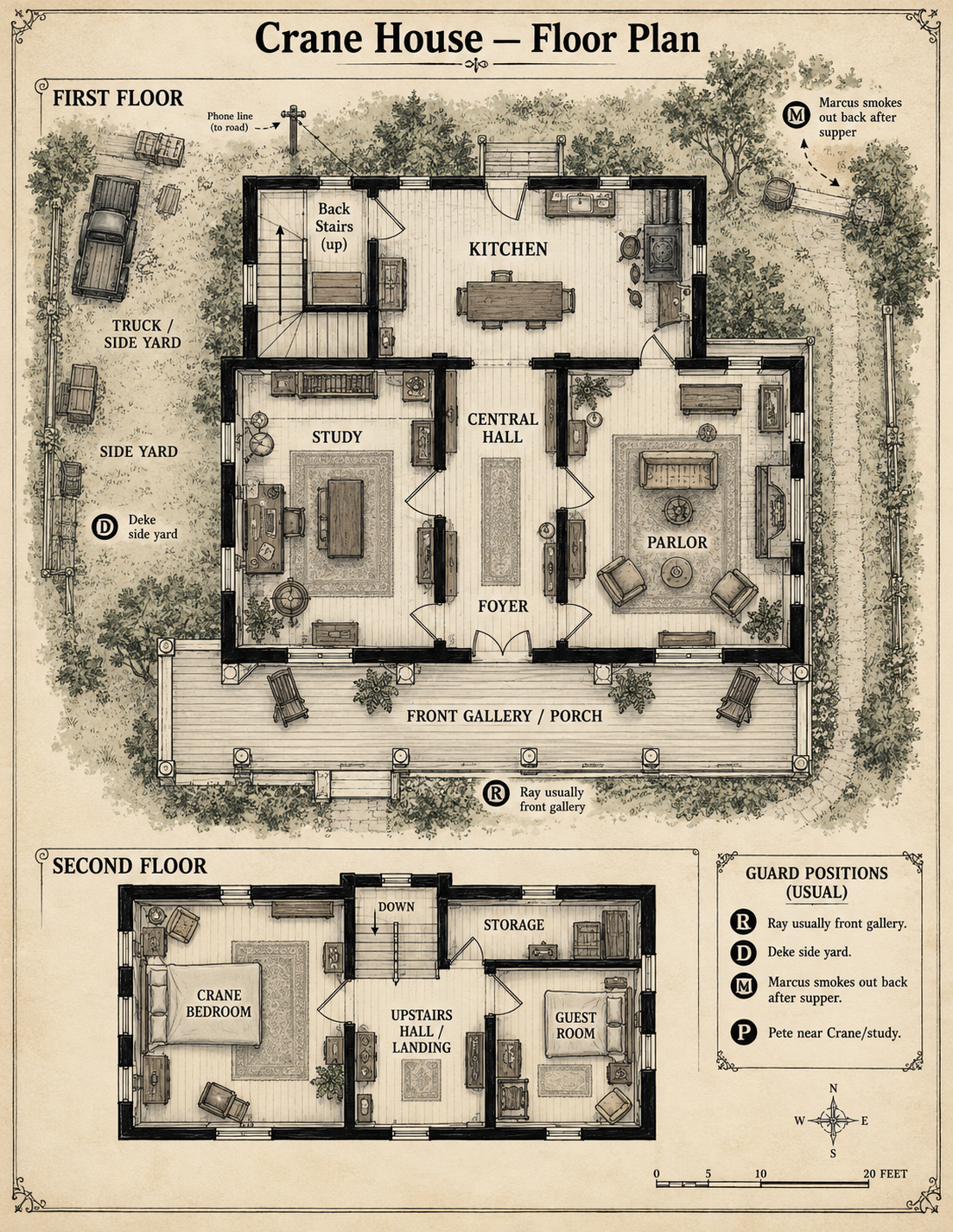
Treat this as a zone map, not measured tactical space. The hall gives access to the study and kitchen. The kitchen is not visible from the study. The front gallery, side yard, and kitchen door are separate approaches. A gunshot is heard everywhere; ordinary conversation through a closed interior door is not. Upstairs is Crane’s bedroom and storage. Nothing there matters.
Ways in
Give observations freely. Roll only under pressure.
| Approach | Opportunity | Likely problem |
|---|---|---|
| Talk past Ray | Crane will hear an offer from the players | Weapons stay outside, or Pete escorts them |
| Kitchen door | Fast route inside; Marcus smokes out back after supper (from Nita) | Marcus comes back early, behind them |
| Distraction | Pulls one or two guards from the study | Advance the Alert Track |
| Cut the phone line first | Crane can’t call Cal or the sheriff | It’s 20 feet from Deke. Stealth TN 15 (20 at Alert 1+). |
The guards
Each guard has a full wound track, but guards will run before they die. They are not bound by the book. A guard at −2 or worse runs or gives up, unless Crane is watching.
| Guard | BOD / AGI | Attack | Weapon | TN to hit him | Wounds per level | Tactic |
|---|---|---|---|---|---|---|
| Ray Guidry | 3 / 2 | 3k2 (Firearms +1) | Pump shotgun, DR 4 | 10 | 6 | Holds the front gallery and demands answers |
| Deke Landry | 2 / 3 | 5k3 (Firearms +2) | .357 revolver, DR 3 | 15 | 4 | Watches the side yard, the truck, and the exits |
| Marcus Bell | 3 / 3 | 5k3 (Melee +2), Stealth +2 | Buck knife, DR 2 (5k2 damage) | 15 | 6 | Tries to cut a hunter and keep the blood. |
| Pete Theriot | 4 / 2 | 4k2 (Brawling +2), 3k2 (Firearms +1) | .45 pistol, DR 3; Kevlar vest | 17 | 8 | Guards Crane and grapples whoever carries the book |
Ray is easy to hit but hits hard. Pete’s vest makes him the one guard worth avoiding. Marcus’s knife is the quiet horror. If he draws blood, he tries to keep it. The book needs new names, and Marcus is recruiting.
Run the guards in waves: Ray or Deke first, then Marcus once the Alert Track reaches 2, then Pete once it reaches 3. Crane wants delay and blood, not a massacre. The guards block doors and grab people before they shoot to kill.
Sneaking past a guard: AGI + Stealth against TN 15, or 20 at Alert 1+. If the hunters move together and Morgan can direct them, use the Leadership team-action rule instead.
Grabbing a weapon:
“I slam the parlor door into Ray and wrench the shotgun sideways.” (for example)
That’s a Contested BOD roll. Alex (BOD 3) against Ray (BOD 3) means each needs 15, and dice below 3 drop.
- Alex wins: Ray loses the gun and is out of the fight.
- Neither succeeds: they wrestle into the next round, and the shotgun blows a hole in the ceiling. Advance the Alert Track.
- Ray wins: he keeps the gun and shoves Alex back into the foyer. Next round, he fires.
SCENE 4 The study
When they reach the study. Beat: surprise.
Crane sits beneath a green-shaded banker’s lamp. The book lies open beside him, one pale hand spread across its pages.
He looks about sixty, until he turns his eyes on you.
On the mantel is a framed photograph: a graveside in 1931, mourners in black, a young man at the head of the casket. It’s the man at the desk. On an easel beside the grave stands a portrait of the deceased. It’s the man at the desk.
The fireplace below is swept clean. There’s no ash and no wood, and a screen is wired shut across it.
“Maren sent you.” He lets the silence stand. “Did she tell you why she wants MY book?”
Fear. When he turns his eyes on them, call for the Fear test (see Rules). Alex shrugs it off. Morgan has to decide whether to spend her scarce Willpower here.
Crane will talk if they try. He wants the book more than he wants them dead. What he says is true.
What he gives up here (suggestions)
- The book binds people. He turns pages-decades-of names gone gray and flaking, then a dozen fresh pages in rust-brown, dated this summer. “This book doesn’t just record debts. It collects them for me.”
- The debts feed him. He admits the named feel compelled to follow his instructions. He says it the way a landlord talks about rent. “This summer half this parish couldn’t make the note on their trucks. I made it for them. Everyone signs something, eventually.”
- A taunt about Voss. “Ask her about the last pair she sent. Ask her where they are.” That’s all he says. He enjoys watching them work it out.
He does not volunteer that burning destroys the book. That stays hidden until the road unless the players uncover it early. The swept, wired fireplace is the visible hint. Pete can be made to admit “he won’t have a fire in the house, not even in January.”
Fail-safe clue: no roll can permanently hide the fire solution. If Crane dies, escapes, or never gets the chance to explain it, a careful look at the inside back cover of the Ledger reveals an old handwritten line: ALL ACCOUNTS CLOSE IN FIRE. Give this automatically once the hunters have a quiet moment with the book.
The counteroffer [Adaptation]
He nudges the rug aside with his shoe. A floor safe.
“Forty thousand. Cash. Walk out and tell her I wasn’t home.”
A pause.
“Or take the book to her and find out what she does with people who know what she has.”
In a broke parish in 1986, forty thousand in cash changes a life. If the hunters take the money and leave, that’s a legitimate ending. Go straight to “Return it to Crane” and let them live with it.
SCENE 5 The grab
Immediately after the study turns against them. Beat: false resolution. Let them win this, and let it feel earned.
When the hunters commit to a coordinated plan, use the Leadership team-action rule. Each hunter rolls their own AGI + Morgan’s Leadership against TN 20. If at least one succeeds, the team succeeds; if both succeed, use the higher result to judge raises; a fumble by either hunter makes the team action fail. If they’re split up, each rolls AGI + Stealth instead.
- Success with one raise or more (25+): they hold the advantage. The opposition can’t act in the first round.
- Success: the fight starts with ordinary initiative.
- Failure: the opposition gets a free round before initiative.
| Plan | With the advantage | On a failure |
|---|---|---|
| Take the book | One hunter has it while the other holds the door | Pete is on the carrier; Crane’s revolver is up |
| Burn it here | The wired screen needs a BOD roll (TN 15) or Alex’s tire iron | Crane covers the fireplace, and a guard blocks the exit |
| Negotiate | Crane stands the guards down to talk terms | He demands they split up and disarm. That kills Leadership. |
After the opening, run combat by the book.
Burning takes real fire. A match or cigarette lighter can scorch the Ledger but will not sustain destruction. A fireplace, stove, bonfire, road flare with fuel, gasoline fire, or equivalent sustained flame will do it. Once the hunters have uncontested substantial fire and time, the book burns with no roll. Under attack, they roll only to win that window; they never roll to see whether the Ledger itself resists.
A removed inscribed page follows the same rule. If completely burned on its own, the bindings written on that page end while the rest of the Ledger survives.
When the book leaves his hand
His grip misses the desk edge.
Gray floods his hair. The skin along his jaw loosens.
For the first time, he sounds afraid.
“You don’t know what you’re carrying.”
[Adaptation] Crane’s two wound tracks. Crane is built on the book’s vampire sheet; his full stats are in the cheat sheet.
- Minor track: guns, knives, and fists. While Crane both owns and physically possesses the Ledger, he heals 4 Minor wounds at the start of every round. Shooting him only buys time.
- Major track: separation from the book. Mark one Major Wound Level the moment the Ledger leaves Crane’s physical possession, and another at the beginning of every subsequent major scene in which it remains away from him. Do not mark separation damage round by round. Major wounds do not heal while the book is away, and each level costs him dice. If someone else claims the Ledger, Crane remains cut off and the deterioration continues.
- If the Ledger comes back to Crane while he still owns it, the marking stops. He can spend one Dark Point per round to heal 4 Major wounds, the book’s rule for healing Major damage. If someone else has claimed it, physical possession alone no longer helps him; he would have to claim it again.
- If the book burns, fill Crane’s Major track. He dies.
Pete goes after whoever has the book. Crane fights to get it back.
The exhale
When they’re in the car and moving, slow down. Ask what the car smells like, what’s on the radio, and whose hands are shaking. Let them think it’s over for one beat.
Then the book falls open in someone’s lap to the last written page.
SCENE 6 The river road
On the road after the escape. Beat: bigger twist. This is where the Rule of 3 breaks the pattern.
In the green glow of the dash lights, the newest ink is darker than the rest. Two names, dated April 1984.
Nita Ames.
Cal Rousseau.
The woman who bagged their groceries was one of the last hunters, and the other was Morgan’s former partner. Voss knew what Crane would do with them. Let that land in silence before anything else happens.
The interception [Adaptation]
Crane doesn’t teleport. This scene happens only if Crane is alive, conscious, still owns the Ledger, and can reach the phone: either Alert step 4 already happened, or the line is still up when the hunters flee and he calls Cal as their taillights leave the drive. If the hunters cut the line before either call, if Crane is dead or unconscious, or if someone else has already claimed the Ledger, there’s no compelled interception. Skip it and deliver Crane’s last offer later only if he can plausibly reach them.
If Cal got the call, he was already idling in the dark. On a two-lane parish road under the oaks, high beams fill the rear window. Then a ’78 Ford pickup swings across both lanes.
Cal is driving. Crane sits beside him, visibly old now and failing.
Cal is the obstacle, and he doesn’t want to be one. His established debt to Crane is pressing him, and he’s fighting it.
Outrunning the truck: Contested AGI + Drive, Alex (3k3) against Cal (5k3). Both need 15, and dice below 3 drop. If Alex wins, they lose him on the back roads, and Crane catches up at the shop instead.
Talking Cal down: resolve this as Ledger pressure. Morgan may use PSY + Psychology or PSY + Leadership instead of Cal’s own PSY resistance and gets +1 die because they were former partners. If Morgan previously broke through to Cal before the house, use that established relationship and current fiction rather than automatically replaying the same beat.
- Hunter/Cal wins: Cal stands down.
- Neither succeeds: he freezes. The contest carries into the next round, and Crane acts in the gap.
- The Ledger wins: he follows Crane’s order this round.
- The CB: if Morgan thinks to key Alex’s CB and talk to Cal on channel 19, let them. Cal answers. That’s worth the extra die.
- Cal’s stats: BOD 3, AGI 3. Firearms +2 (5k3), .38 revolver DR 3, Drive +2. TN 15 to hit, 6 wounds per level.
- Hurting Cal is easy. Players who do it should feel it.
- Hunters who burned the book in the house skip this scene entirely.
If the hunters never speak to Crane [Adaptation]
A competent infiltration can bypass Crane entirely. Do not force a confrontation. The scenario must still make sense.
By the time the hunters are free to make the final choice, make sure they can assemble these truths from other sources:
- Nita/Cal: blood, the cut palms, the written name, the pressure of an established obligation, and Voss’s involvement in 1984.
- The Ledger itself: on the inside cover, in old cramped handwriting: ALL ACCOUNTS TERMINATE IN FIRE. This is the fail-safe for learning that destruction ends the bindings.
- Physical evidence: newest pages contain Nita Ames and Cal Rousseau, dated April 1984; older names gray and flake as debtors die.
- Voss’s behavior: the 1984 folder, her white gloves, and her fixation on the last page establish that she knows more than she admits.
Crane’s conversation remains valuable because it gives his version of the truth and the counteroffer, not because it is the only route to essential information.
Crane’s last offer
If the hunters still don’t know that burning ends the bindings, Crane tells them here. He has nothing left to hide. If Crane cannot do so, use the fail-safe line written inside the Ledger instead. By the end of this scene, the players should know what burning does.
“She sent those two to see if I’d keep them. She’s studied this book for twenty years. She knows what it does to people. She just wanted to learn how I do it.”
He looks at the book in your hands.
“Give it back and I live, and they stay mine. Burn it and I die, and they’re free. Or take your money. But don’t call the last one mercy.”
He’s telling the truth about the choices, but he doesn’t get to make it for them.
SCENE 7 The handoff
Before dawn, Baton Rouge. Beat: maximum tension, then the climax. The players know everything now. All that’s left is the choice. Use whatever clock time follows naturally from their night; Voss only cares that they arrive before sunrise.
The street is empty except for a garbage truck two blocks down. The shop lamp is on. Voss lets you in and turns the bolt behind you. In the back room, a cast-iron stove ticks as it heats.
She takes the book in gloved hands. She doesn’t check the clasps or the binding.
She turns straight to the last page.
Two names. The faintest smile.
Then, for the first time tonight, she removes one glove.
The bank envelope with $15,000 is on the counter. She stays composed throughout.
What she says
- On the job: “You took a job. You did it. Nothing he told you changes our agreement.”
- On the lie: “Would you have gone if I’d told you everything?”
- On Nita and Cal: “They failed, and failure has a price. You didn’t fail.”
- To Alex: “That warrant is still in a drawer somewhere. I’d hate to remember which one.”
She has no binding attack. She cannot bind anyone by reading their name. Adding a debtor takes blood and ink. Simply holding the Ledger does not transfer Crane’s debtors. If the hunters allow the handoff to continue, Voss pricks one finger with a letter opener and touches a drop of her blood to the inside cover. That is the claim. The existing debts become hers immediately.
If a hunter snatches the Ledger before she claims it, Crane remains the owner and the Named remain under his pressure even though the book is out of his hands.
Keep the choice open
Arriving at the shop isn’t surrender. The hunters can grab the book back, refuse the money, bargain, or feed the book to her stove. The stove is there on purpose.
If the hunters disagree, let them. Two hunters with opposing hooks, a stove, and $15,000 make the best scene in the session. Don’t resolve their split for them.
Endings
Every ending closes on Nita or Cal, the parish’s face. The players should leave knowing what their choice did to a specific person.
Return it to Crane
His aging stops, and he lets them go. The parish stays his, and Voss gets nothing.
The study lamp stays on behind you.
Weeks later you buy gas on 61 on the way to another job. The woman at the register rings you up before you ask. She smiles. She doesn’t remember you.
Burn it
If Crane is still alive, the years catch him and he dies. Every binding ends. The named recover without quite knowing why. Voss doesn’t pay.
The last page curls inward.
Every name on every page goes gray at once. For a moment the room holds only fire, paper, and a very old man.
Then the paper is ash.
On a parish road, Cal Rousseau sits in a pickup he doesn’t remember buying and starts to cry. At the Fina station, Nita Ames takes a breath that feels like her own, walks out from behind the counter, and doesn’t come back.
Monday morning, Mrs. Fontenot finds the deed books open on her desk, and doesn’t remember why.
Then give each hunter one personal consequence.
Morgan: within a day or two, Cal calls. He remembers enough now to know what Morgan did for him. The call can be brief: “I remember everything.”
Alex: Voss no longer has a reason to keep his federal warrant buried. Within the week, an old problem becomes current again: a message from a lawyer, a federal agent asking questions, or word that somebody has reopened the file. Do not turn this into an immediate arrest unless the campaign wants that; the point is that burning the Ledger cost Alex something real.
If the hunters burned only a removed page, use the same style of epilogue for the people freed, while everyone else in the Ledger remains bound.
Deliver it
Voss claims the Ledger, pays, and the parish gets a new owner.
Three weeks later, a postcard comes to Morgan’s office. No return address. A picture of the courthouse in St. Francisville.
On the back, in Cal’s handwriting: Things are better here. Everybody’s helpful. Ms. Voss knows everyone.
Below it, in a different hand: Thank you.
You look at the money. You did the job.
Keep it [Adaptation]
Tell the players plainly: carrying the Ledger is not enough. To keep its power, one of them has to claim it with their own blood. Until then Crane remains the owner, even while separated from it.
If a hunter claims it, every existing debt transfers immediately and begins feeding the new owner. Nita and Cal’s existing debts transfer to that hunter, with the same original obligations and limits.
Ask the new owner: “What do you tell yourself makes this different?” Don’t force them into villainy. Let their answer hang.
Epilogues
Give each hunter one short closing scene: a beer with their partner at a bar on Airline Highway, a confession, a visit to Nita, or a lead on where the book came from. Then ask:
“What follows you home from this job?”
If the pair continues as a campaign, award XP by the book. Give 1–3 per session for acting on what they learned. At the end of the Hunt, add a bonus: 3 for burning the ledger cleanly, 2 for burning it with injuries, 1 for burning it at heavy cost, and none if it survives.
Keeper cheat sheet
Ledger quick rules [Adaptation]
- Possession is not ownership. Stealing the book cuts the owner off from its life-sustaining effect but does not transfer ownership of the Named or the right to press their debts.
- Claim: while holding the Ledger, put a drop of your own blood on the inside cover. Existing debts transfer immediately.
- Obligation, not open-ended commands: the debt’s scope is fixed when the binding is created. An owned Ledger presses that established obligation at Rank 4. An unclaimed Ledger cannot actively press a debt.
- Distance: the obligation persists at any distance, but its scope does not expand.
- New binding: debtor’s blood + owner’s blood + debtor’s written name + the obligation being established.
- Pages: tearing out an inscribed page does not free anyone. Put it back and it reattaches seamlessly.
- Selective fire: completely burning a removed inscribed page ends only the bindings on that page.
- Whole-book fire: sustained substantial fire destroys the Ledger and ends every binding; a match alone is not enough.
- Crane: one Major Wound Level on separation, then one per subsequent major scene. Never per round.
Cast
| NPC | Wants | Voice line |
|---|---|---|
| Maren Voss | The Book and immortality | “Intact.” |
| Elias Crane | The book back, and time | “Did she tell you what she wants?” |
| Nita Ames | To be helpful (the book’s pull) | “Mr. Crane takes care of folks here.” |
| Cal Rousseau | To stop, and he can’t | “Please get out of the road.” |
| Mrs. Odile Fontenot | To protect Mr. Crane, without knowing why | “The Crane men always did favor each other.” |
| Ray / Deke / Marcus / Pete | Paid, and live | “Hands where I can see ’em.” |
Elias Crane [Adaptation: built on the vampire sheet]
| Rank | BOD | AGI | MIN | PSY |
|---|---|---|---|---|
| 4 | 2 | 2 | 4 | 4 |
- No Willpower. He has 4 Dark Points, fed by his debtors. He can spend one per round for an extra die and to keep every die he rolls.
- Traits: Fear. Regeneration: 4 Minor wounds per round for free, but only while he both owns and physically possesses the Ledger. Major wounds heal only at 1 Dark Point per 4 wounds once the Ledger is back in his possession and ownership.
- Attack: .38 revolver from the desk drawer, 3k2 (Firearms +1), DR 3. TN to hit him is 10. Hunter’s Inc says vampires have no skills; Crane is still a man, so he keeps this one.
- Wounds: 4 per level, on two tracks. Minor is physical damage. Major is losing the Ledger.
- Vulnerabilities: Separation from the Ledger marks one Major Wound Level immediately and one more at the beginning of each subsequent major scene. Separation damage is never marked round by round.
- Like the book’s vampires, he never explodes 10s, never fumbles, and can’t bid up.
Others
- Maren Voss: BOD 2, AGI 2, MIN 4, PSY 4, WIL 2. Confidence +2, Occult +2. Unarmed; her weapon is leverage.
- Nita Ames: BOD 2, AGI 2, MIN 2, PSY 3, WIL 1. Streetwise +1. Resisting the Ledger uses the Ledger pressure rule against Rank 4.
- Cal Rousseau: BOD 3, AGI 3, PSY 3. Firearms +2, Drive +2. .38 revolver DR 3. TN 15 to hit, 6 wounds per level. Morgan gets +1 die when using their former partnership to help Cal resist.
- Mrs. Fontenot: PSY 2. Bureaucracy +2. Not a threat; a gatekeeper.
1986 texture
- Phones: wall phones, payphones (bring change), no caller ID, answering machines and answering services. To reach someone on the road, use a CB or a pager.
- Records: deed books, microfilm, and the clerk’s memory. No database.
- Gear: Polaroids, a Maglite, a Walkman, a road atlas, cassettes in the dash.
- The parish: for-lease signs, oil-field families, the cooling tower north of town, live oaks and moss.
Principles
- Give them the job before revealing its cost.
- Let competent plans work.
- Keep the threats physical: guns, doors, distance.
- Reward period-smart play, like cutting the phone line or working the deed room.
- No roll ever locks away essential information.
- A name by itself does not bind anyone; binding requires both bloods and the written name.
- Make sure they know every meaningful option before the final choice, whether or not they ever speak to Crane.
- NPCs provide believable observations, not optimal tactics.
- Let investigation deepen with time and focus; do not require bids for clues the players could not know exist.
- Let the hunters disagree. Don’t settle the ending for them.
Additional Sources
- Adapted The Ledger to the rules from Hunters, Inc., by John Wick with David Williams, in SHADIS #32. Everything marked [Adaptation] is new to this version.
- Oil price drop works hardship on Louisiana, Christian Science Monitor, April 23, 1986.
- River Bend Nuclear Generating Station, Wikipedia. Commercial operation began June 16, 1986.