The Dancing Plague of 1518
A Fantasy Adventure of Mystery, Fear, and Forbidden Secrets
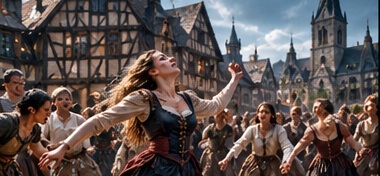
A strange affliction has descended upon a prosperous city. It begins with a single citizen dancing in the street, seemingly unable to stop. Within days there are dozens. Soon the city’s squares are filled with men and women staggering through an endless dance, their clothing soaked with sweat and their feet bloodied against the stones. Some collapse only to begin again when they awaken. Others do not awaken at all. Physicians disagree over the cause, priests proclaim warnings of divine displeasure, and frightened citizens whisper of curses, witchcraft, and worse things waiting beyond the city walls.
The Dancing Plague is a fantasy investigation adventure inspired by the extraordinary events that occurred in Strasbourg in 1518. It is designed to be inserted into an existing fantasy campaign with minimal alteration. The afflicted city can replace any moderately sized settlement within the Game Master’s world, while the surrounding villages, dominant religion, religious hierarchy, and political authorities can be adapted to fit the campaign. The adventure assumes only that organized religion exercises significant influence in the region and that travel between neighboring settlements remains common enough for rumors, merchants, pilgrims, and disease to move between them.
The characters are drawn into the crisis when they are asked to investigate the mysterious sickness. What initially appears to be an outbreak of supernatural origin gradually becomes something far more deliberate. Their investigation will take them from crowded streets to a neighboring town, a solemn funeral, the laboratory of a suspected necromancer, and the hidden affairs of influential figures within the dominant faith. Along the way they will contend with frightened townspeople, starving brigands, hired killers, suspicious clergy, and people willing to commit terrible acts in defense of secrets buried years before.
At the heart of the adventure are three questions that emerge in stages: What is causing the dancing? Who is responsible? And why would anyone inflict such suffering? Each answer changes the meaning of what the characters have already witnessed. The players should discover those answers through their choices and investigation, not through the opening description.
Historical Background: The Dancing Plague of 1518
The inspiration for this adventure comes from an actual and still unexplained event that occurred in Strasbourg in the summer of 1518, when the city was part of the Holy Roman Empire. According to historical accounts, the episode began in July when a woman generally identified as Frau Troffea began dancing in the street without apparent musical accompaniment. She continued for days despite exhaustion. Other residents soon began exhibiting similar behavior, and within weeks contemporary accounts described dozens—and eventually perhaps hundreds—of people caught up in the strange dancing epidemic.
The phenomenon was considerably more disturbing than the word dancing might suggest. Accounts describe people moving compulsively for extraordinary periods of time, sometimes until they collapsed from exhaustion. Later chroniclers reported deaths associated with the outbreak, including claims of victims succumbing to exhaustion and other medical consequences, although the precise number of deaths is uncertain and some of the most dramatic figures come from later accounts. By August, sources claimed that as many as 400 people had become involved in the outbreak.
Strasbourg’s authorities responded according to the medical and religious understanding of their time. Physicians reportedly diagnosed the problem as a natural illness associated with overheated blood. In one of the strangest episodes of the crisis, officials initially concluded that the afflicted should be allowed—or even encouraged—to dance until the condition had exhausted itself. Dance spaces and platforms were provided, musicians were employed, and healthy dancers were apparently brought in to assist. Rather than ending the outbreak, the measures coincided with its expansion, and the authorities eventually abandoned the strategy.
Religious explanations increasingly shaped the response. Saint Vitus had long been associated in European popular belief with involuntary dancing and with the possibility of a divine dancing curse. Public dancing and much music were eventually restricted, while some of the afflicted were taken to a shrine of Saint Vitus for religious treatment. By late August or September, the extraordinary outbreak had subsided. Strasbourg was not entirely unique: episodes of so-called dancing mania had occurred elsewhere in medieval and early-modern Europe, particularly along the Rhine and Moselle regions, although the events of 1518 became perhaps the most famous example.
More than five centuries later, there is no universally accepted explanation for what happened. Ergot poisoning from contaminated rye has frequently been proposed, since ergot can cause hallucinations and convulsions, but historians have pointed out that its physiological effects do not readily explain people dancing for prolonged periods. Historian John Waller has instead argued that the outbreak is best understood as a form of mass psychogenic illness occurring among a population suffering extraordinary social and psychological stress. Strasbourg and its surrounding region had endured poor harvests, hunger, disease, and intense religious anxiety, creating conditions in which beliefs concerning Saint Vitus and divine punishment could have shaped how distress manifested itself. Whatever its ultimate cause, the Dancing Plague of 1518 remains an extraordinary example of an event in which medicine, religion, fear, and social crisis became almost impossible to separate.
Online Resources
For an accessible overview, see History — “What Was the Dancing Plague of 1518?”. For a more detailed treatment drawing heavily on historian John Waller’s research and discussing contemporary accounts, the competing explanations, Saint Vitus, and the social conditions surrounding the outbreak, see The Public Domain Review — “The Dancing Plague of 1518”.